Thrihnukagigur Volcano Tour: Both Descents to the Magma Chamber, from $433
A crane sits over the crater from May to October and lowers eight people at a time down a 120-metre shaft into rock that last held liquid magma 4,500 years ago. Two operators sell that Thrihnukagigur volcano tour, and this page sets their prices, their pickups and their timings side by side.
A Thrihnukagigur volcano tour costs $433 or $554 depending on the listing, and both put you in the same open lift down the same shaft. The $121 gap is the Reykjavik hotel transfer, which the cheaper listing sells as an add-on at checkout and the dearer one builds into the price. Every departure includes a 3 km hike each way across the Blafjoll lava field, roughly 30 to 40 minutes on the chamber floor, and lamb soup at base camp. The season runs from May 5 to October 30 only.
Key takeaways
Cheapest and most reviewed: $433 per person, rated 4.9 from 628 reviews, run by the operator that holds the crater concession
With transfer included: $554 per person, rated 4.7 from 172 reviews, picking up at most Reykjavik hotels and the cruise terminal
Included on both: helmet, harness, guides, and all-you-can-eat Icelandic lamb or vegetable soup with coffee and hot chocolate
Not included: hiking boots and waterproofs, which you bring yourself. Sneakers and jeans are turned away
Minimum age is 8 years and the walk is graded moderate, with a steep 50-metre climb at the very end
Neither listing charges today, and both cancel free up to 24 hours before departure, which matters when the mountain weather turns
Book early in the season: the lift is craned out every autumn and there is nothing to descend from November to April
Free cancellation 24h
Reserve now, pay later
Mountain rescue guides
All safety gear issued
120 mLift descent to the chamber floor
4,500 yrsSince the last eruption
3 kmLava-field hike, each way
May–OctThe only months the lift is there
best price
The Listing Most People Book
Inside Thrihnukagigur: Guided Hike and 120-Metre Crater Descent
★★★★★★★★★★4.9(628 reviews)
Run by Inside the Volcano, the operator that holds the concession on the crater itself, and the cheaper of the two ways to get down there. You meet at the Breiðabliksskáli ski cabin in Bláfjöll, walk 45-50 minutes across the lava field, then ride the open lift 120 metres (400 feet) into the magma chamber in parties of four to five. Up to an hour inside. Icelandic meat soup, coffee and hot chocolate at the cabin afterwards. Transfer from Reykjavík is an option at checkout, not automatic.
Duration
4 to 6 hours, or about 4 if you drive yourself to Blafjoll
Meeting Point
Breidabliksskali ski cabin, Blafjoll, roughly 30 minutes from Reykjavik
Included
Guides, helmet, harness, all safety gear, Icelandic meat or vegetable soup, coffee, tea and hot chocolate
Price Range
$433 per person, sold by the operator that runs the crater itself
Departures run several times a day through the summer and the morning slots fill first. Pick a date to see the times still open and the price in your own currency.
Inside the Volcano: Small-Group Tour and Lava Field Hike with Reykjavík Pickup
★★★★★★★★★★4.7(172 reviews)· 5 - 6 hours
The same descent into the same crater, sold by Gray Line Iceland with hotel pickup built into the price rather than bolted on. Pickup from most Reykjavík hotels…
Pickup from most Reykjavík hotels and the Skarfabakki cruise terminal, included
400-foot (120 m) lift descent into the magma chamber
3 km (2 mile) guided hike across the Bláfjöll lava fields each way
Both listings sell the same descent into the same crater, guided by the same mountaineers, finishing with the same soup. Read the rows that differ rather than the ones that match.
The $433 listing
The $554 listing
Book
Price per person
$433
$554
Reykjavik pickup
Paid option at checkout
Included in the price
Duration
4 to 6 hours
5 to 6 hours
Rating
4.9 from 628 reviews
4.7 from 172 reviews
Group size
Whole group, then parties of 4-5 in the lift
Capped at 18 travellers
Minimum age
8 years
8 years
Cancellation
Free up to 24 hours ahead
Free up to 24 hours ahead
Suits
Anyone with a hire car, or happy to add the bus
Cruise passengers and anyone without wheels
What the Day Actually Looks Like
Getting to Blafjoll, and the Turn People Miss
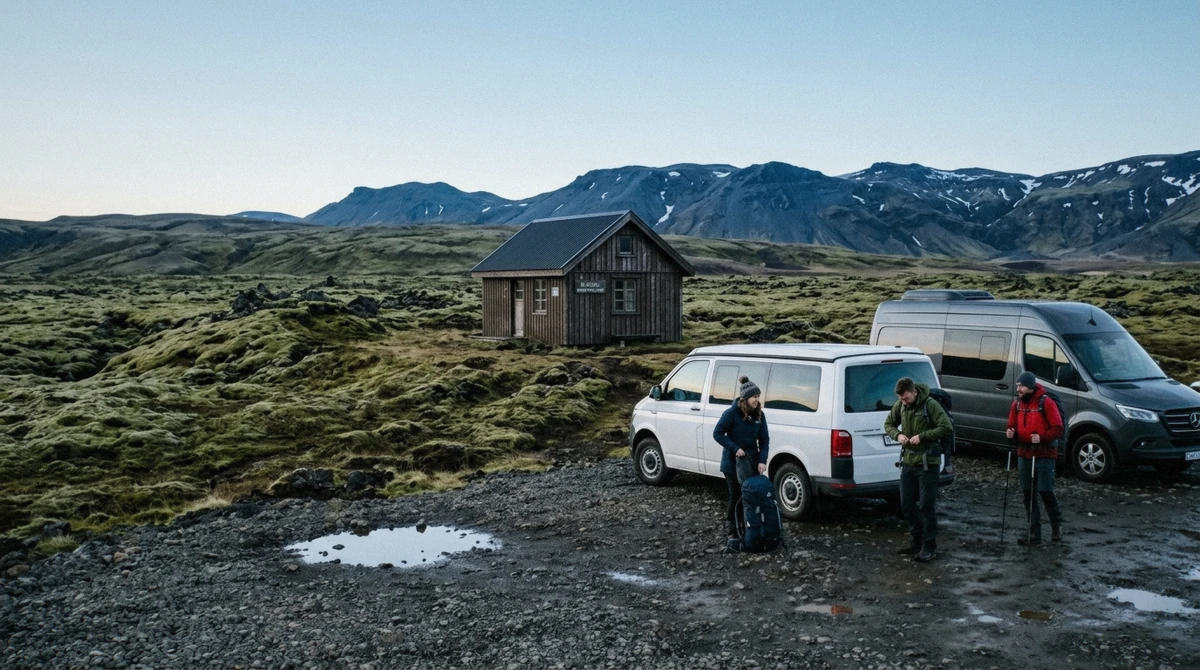
The tour does not start in Reykjavik. It starts at Breidabliksskali, a ski cabin in Blafjoll, the Blue Mountains sitting about 20 km southeast of the capital inside a country park. The drive takes 30 to 35 minutes on paved road.
Driving yourself: take road 1 east out of the city for about 15 minutes, turn right onto road 417, Blafjallavegur, and stay on it as it becomes road 407 towards the skiing area. There is one turn that catches people out. Do not take the gravel track off 417. Keep going and a sign reading "Inside the Volcano, Parking 300 meters" appears about ten minutes after you leave road 1. The car park sits at 63.98502 N, -21.649949 W.
Taking the bus: the $554 listing collects from most Reykjavik hotels and from the Skarfabakki cruise terminal, and the fare is inside the price. The $433 listing offers the same coach as a paid extra you tick at checkout, which is where the difference between the two comes from.
Driving yourself cuts the day to roughly four hours instead of six. If you are already renting a car, that is the cheaper and shorter version of the same tour.
The Hike: 3 km Out, and 50 Metres of It Uphill
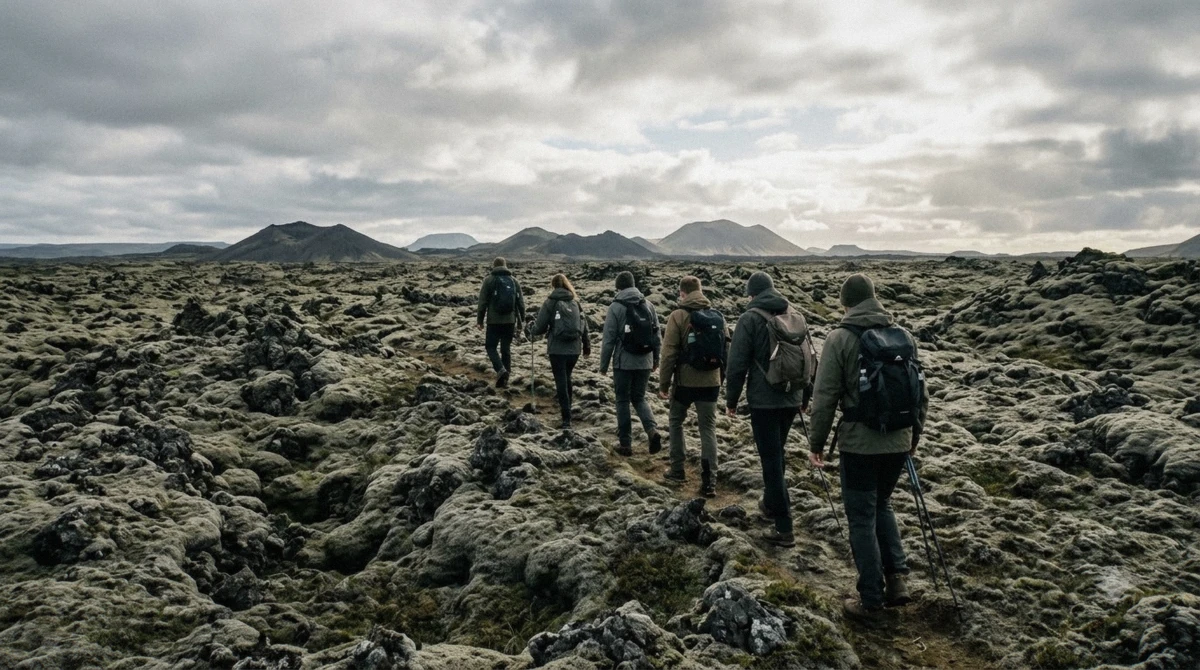
Guides brief the group at the cabin and then lead the walk across the lava field. The path runs about 3 km, or 2 miles, each way and takes 45 to 50 minutes at group pace.
Nothing about it is technical. The ground is what makes it work: broken lava under a skin of moss, hummocky, uneven, and wet after rain. Reviewers who found it hard were almost always fighting the weather rather than the gradient, and 50 mph wind with rain turns a 45-minute walk into 90.
The last stretch is the one worth knowing about. From base camp up to the crater rim you climb about 50 metres, roughly 150 feet, and it is steep enough to notice. Guides take it slowly and nobody is left behind, but this is the section that decides whether a tired traveller enjoys the day.
Round trip you cover 6 to 7 km on foot. Two travellers who went with children aged 12 and up called it easy; both said to do it early in the trip rather than after three days of other tours.
Base Camp, and Why Everything There Arrived by Air
Base camp sits at the foot of the cone: a warm hut with restrooms, wireless internet, a small shop, and the soup pot. It is also the reason the tour costs what it costs.
The camp stands in the middle of the capital's water protection area, so no vehicle may drive to it. Every part of it flew in by helicopter, including the lift itself, which is craned into place each spring and taken out each autumn. When a batch of soup meat is too heavy for the guides to carry, that flies in too.
You get coffee, tea or hot chocolate here, then the safety briefing and the gear. Helmet and harness go on and stay on until you are back on the surface. All equipment and procedure has been tested and approved by Iceland's Administration of Occupational Safety and Health, and the guides who run the descent are working mountaineers, many of them serving members of Icelandic wilderness rescue teams.
The Lift Was Built to Clean Skyscrapers
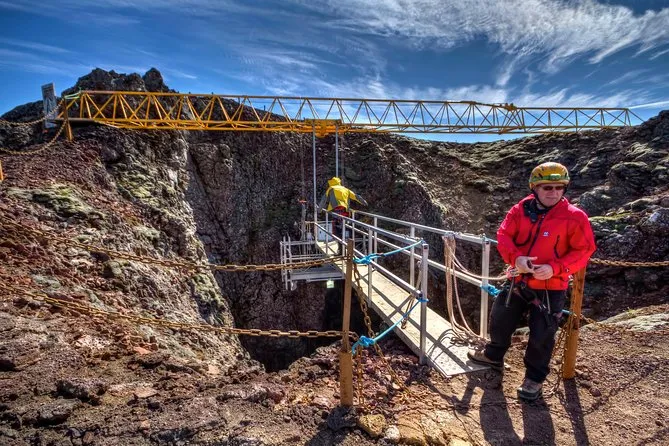
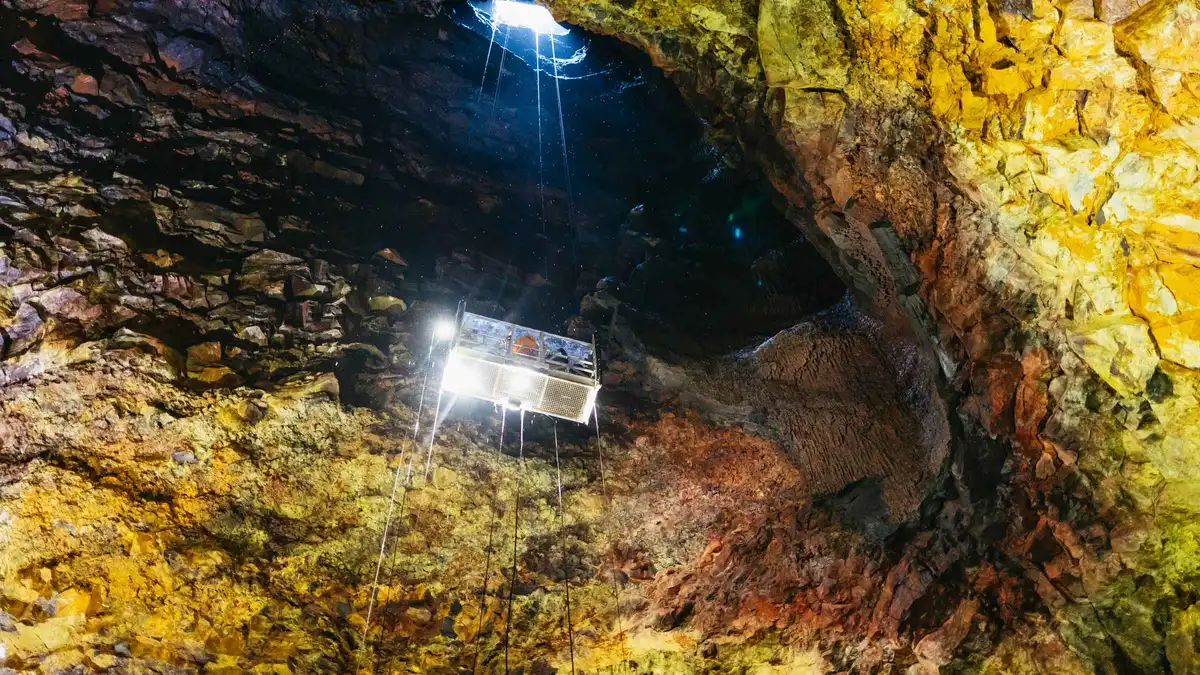
The crater opening is a funnel roughly 4x4 metres, or 12x12 feet, across. Over it stands a crane, and hanging from the crane is a basket that holds seven or eight people. The design is a heavily modified window-cleaning platform, the kind used on the side of tall buildings, adapted after a 2010 National Geographic shoot proved that ropes alone would not carry film crews and equipment in and out.
The ride down takes about six or seven minutes for 120 metres, or 400 feet. That is deliberately slow. You are clipped in, a guide operates the winch, and for the first stretch the shaft walls run close enough to touch before the rock falls away and the chamber opens out beneath your feet.
People who dislike heights tend to do better here than they expect. The basket has solid sides, the descent is steady rather than free-hanging, and reviewers consistently describe it as calm. One traveller wrote that the lift was "not scary in the least" and noted you are harnessed on top of that.
Hiking boots with ankle support. Sneakers and jeans are named as unsuitable by the operator
Warm layers and full waterproofs, including waterproof trousers if you own them
Gloves and a hat, useful even in July: the chamber sits at about 4°C
A camera. Phone photos struggle with the light down there but everyone takes them anyway
Nothing to eat. Soup, hot drinks and sweets are included at base camp
On the Chamber Floor
The floor measures roughly 50 by 70 metres, about 160 by 220 feet. Put three full basketball courts side by side and you have the footprint. Stand the Statue of Liberty inside and it fits. Below the floor, volcanic passages carry on down to a total depth of near 200 metres, or 700 feet, which is why the chamber is the deepest formation of its kind on the planet.
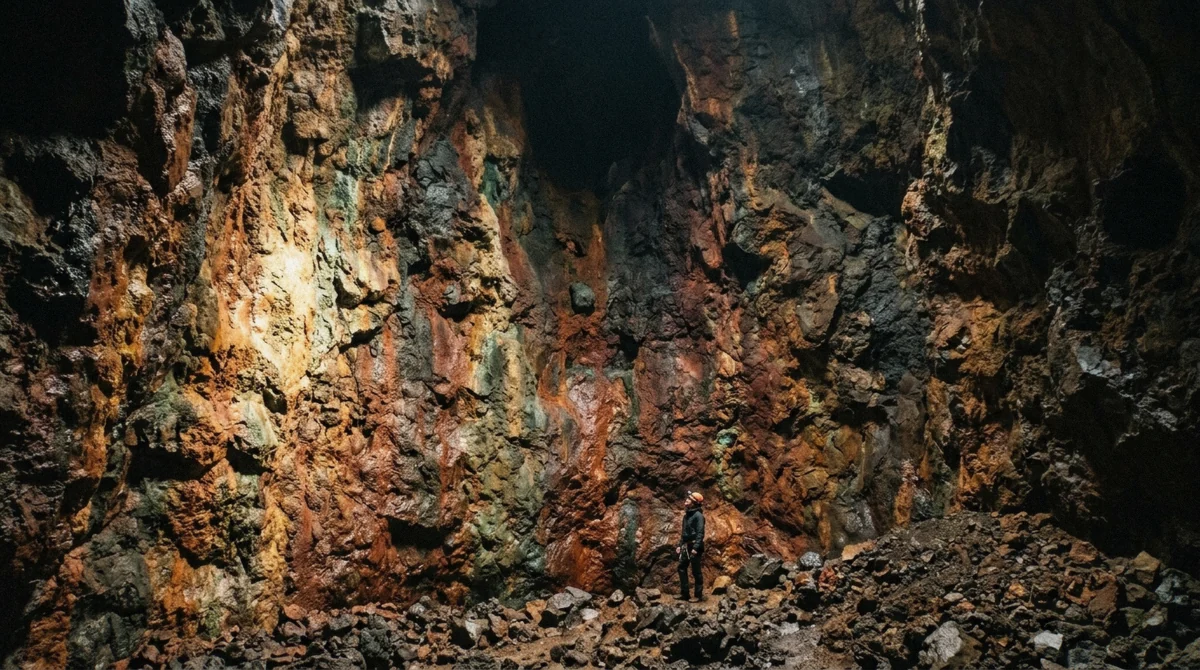
What people photograph is the colour. Iron, sulphur and copper compounds have stained the walls red, ochre, green and black in bands that shift as the floodlights move across them. The lighting is permanent and aimed, so the chamber reads far better in person than in any picture taken from the rim.
Guides stay with you the whole time and you are free to walk the floor. There is no set route and no barrier, just a lit space the size of a cathedral inside a mountain.
How Long You Actually Get Down There
This is the one number the listings disagree on, and it is worth setting straight before you pay $433 or $554.
The operator's own page says you spend about 30 minutes on the ground inside. Arctic Adventures, reselling the same departure, says approximately 40 minutes. The cheaper listing says up to an hour. Travellers who went in 2025 and 2026 report something shorter: one wrote that time inside was 20-25 minutes, another rated the tour three stars in June 2026 with the complaint that it felt rushed for the money.
All of those can be true at once. Groups descend in parties of four to five and the lift cycles continuously, so total time in the chamber depends on where your party falls in the queue and how many people the crew has to move that day. Plan for half an hour and treat anything beyond it as a bonus.
If the number is what decides it for you, the private booking is the honest answer. It costs several times more and buys the crater without a queue.
Source
Time quoted inside
Checked
Soup, Then the Walk Back
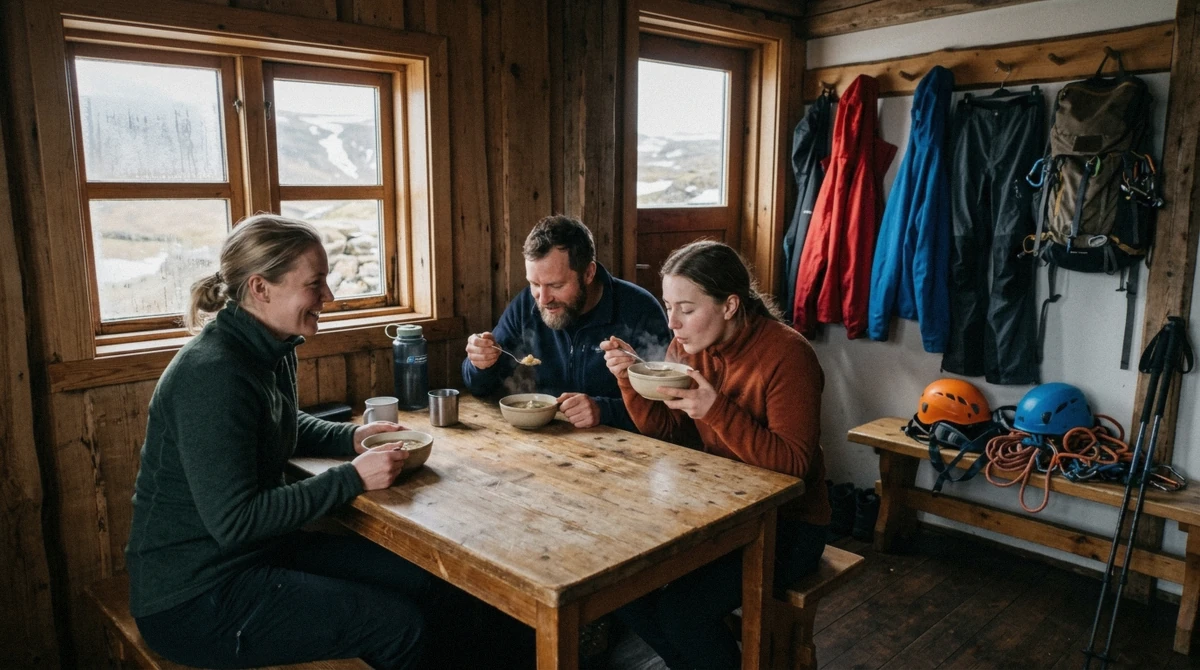
Back on the surface you wait at base camp while the rest of the group cycles through the lift, and that wait is where the lamb soup happens. It is traditional Icelandic kjotsupa, refillable, with a vegetable and vegan version, plus coffee, tea and hot chocolate.
Reviewers mention it more than almost anything else on the tour. One family compared it favourably to the lamb stew they later paid for in a Reykjavik restaurant. Another traveller, writing in August 2025, was disappointed that nothing is served during the earlier break at the hut, only hot drinks, so eat breakfast.
Then you walk the 3 km back across the lava with a guide, and the coach is waiting in the car park. Reykjavik drop-off follows for anyone who came by bus.
The Descent, Metre by Metre
Thrihnukagigur is a bottle: a narrow neck at the surface opening into a chamber that widens the further down you go. This is what the lift passes through.
0m
The crater rim
A cinder cone standing about 35 metres above the lava field, with a funnel-shaped opening roughly 4x4 metres wide. The crane sits directly over it.
20m
The neck
The first stretch of the shaft, close enough to see the rock texture from the basket. The lift moves at about 20 metres a minute.
80m
Where it opens out
The shaft widens and the walls fall away. This is the point every reviewer describes: the floor appears far below and the sense of scale lands.
120m
The chamber floor
120 metres, or 400 feet, below the rim. The floor measures about 50 by 70 metres, big enough for three basketball courts, tall enough for the Statue of Liberty.
200m
Passages below
Volcanic conduits continue down to roughly 200 metres, or 700 feet, in total. That part is closed to visitors and is what makes this the deepest formation of its kind.
The magma that once filled all of this appears to have drained back into the earth rather than solidifying in place. Nobody has explained why.
The Meeting Point, and How to Find It
Tours meet at the Breidabliksskali cabin in Blafjoll, about 20 km southeast of Reykjavik at 63.98502 N, -21.649949 W. From the city: road 1 east, right onto road 417 Blafjallavegur, then straight on as it becomes 407. Ignore the gravel track. The car park is signposted 300 metres before it.
Why the Season Stops on October 30
The lift is not a permanent structure. Crews fly it in each spring and take it out each autumn, so the tour runs from May 5 to October 30 and not one day longer. The bars show daily daylight hours in Reykjavik, the figure below each is the average daytime high in Celsius.
5h daylightJan2°C
8h daylightFeb3°C
11h daylightMar3°C
15h daylightApr6°C
18h daylightMay10°C
21h daylightJun12°C
20h daylightJul14°C
17h daylightAug13°C
13h daylightSep10°C
10h daylightOct6°C
6h daylightNov3°C
4h daylightDec2°C
June to August: warmest, longest days, book weeks ahead
May, September and October: quieter, wetter, colder walk
November to April: the lift is out, no descents at all
Chamber temperature holds near 4°C whatever the month, so the season affects the walk in and the queue rather than the crater itself.
The Volcano Itself
Three Peaks, One of Them Hollow
Thrihnukagigur translates as Three Peaks Crater, and the name covers a row of three cones standing within a few hundred metres of each other on the highland edge, each reaching about 550 metres in elevation.
They are not the same age. The westernmost is hyaloclastite, rock quenched in ice and meltwater, formed in an eruption under a glacier more than 50,000 years ago when most of Iceland lay beneath an ice cap. The middle cone came about 500 years before the youngest. And the youngest, the northeasternmost, is the one with the hole in it.
That cone erupted about 4,500 years ago and has been dormant ever since, with no sign of waking. Iceland as a whole averages an eruption every 3-4 years, because the island straddles the Mid-Atlantic Ridge where the Eurasian and North American plates pull apart. Thrihnukagigur sits in the middle of that ridge and does nothing at all.
Somebody Pulled the Plug
When most eruptions end, the magma left in the chamber cools where it stands and seals the volcano shut. That is the normal outcome, and it is why you cannot walk into the heart of any other volcano on Earth.
Here the magma left. It drained back down into the depths and took nothing with it, leaving the chamber standing empty. The volcanologist Haraldur Sigurdsson put it plainly: "It's like somebody came and pulled the plug and all the magma ran down out of it."
Why it happened here and nowhere else is unresolved. What the walls preserve is the record: rock that has been sitting in this shape since around the time modern humans first spread across the planet, plus microbial life inside the chamber that geologists study for clues about how life develops in extreme places, including on other planets.
From One Man on a Rope to a Booking Page
On a bright winter day in 1974, the cave explorer Arni B. Stefansson had friends lower him through the opening on a rope. He was the first person ever to stand on that floor.
His brother Einar and Einar's friend Bjorn Olafsson began serious exploration in 1991, going down repeatedly in harnesses with headlamps and belay devices to map the cavern. In 2004 Arni first proposed a tunnel into the chamber so that other people could see it. The tunnel was never built.
What did get built was the lift, devised for the National Geographic expedition that filmed inside in 2010, and opened to the public in 2012. The operator, 3H Travel, has run it every summer since, and it remains the only public access to a magma chamber anywhere. There is no self-guided version and no way in on your own: the alternatives on offer are a helicopter transfer to the crater for anyone who cannot manage the hike, or a private booking of the whole site.
What People Wrote After Going Down
★★★★★★★★★★
Our family LOVED this experience! Walking around the inside of a volcano feels like an other worldly experience, just incredible. The guides were great! There was a mama and 3 baby Arctic foxes at base camp that was another highlight! If you are on the fence about going, just do it.
Carrie · United States · July 2026
★★★★★★★★★★
This is a once-in-a-lifetime experience. Much more impressive than photos represent! I would highly recommend they add waterproof pants to the must bring list in addition to hiking boots. They provide long rain slickers but they still drip onto pants if raining on the 45 minute trek, which is common. Soup, hot chocolate, coffee, water provided after the hike at the cabin.
Karen · United States · July 2026
★★★★★★★★★★
Such an excellent trip. The hike up to the volcano entrance was good — not too long, not too steep. The inside of the volcano was so beautiful, very interesting to see all of the different coloured rocks. The soup served after the exploration was delicious.
Leslie · Canada · August 2026
The colour comes from iron, sulphur and copper compounds left in the rock. The floodlights are permanent, which is why the chamber looks better in person than in photographs taken from the rim.
How to Choose Between the Two, and Against Everything Else in Iceland
Renting a car decides it
Drive to Blafjoll and the day runs about four hours instead of six, and the $433 listing is the whole cost. Without wheels, price the transfer into both before comparing.
Cruise days favour the pricier listing
It collects at Skarfabakki cruise terminal and caps the group at 18. Total 5 to 6 hours door to door, which fits a standard port call with room to spare.
This is not a lava tunnel
Raufarholshellir and Vidgelmir are horizontal tubes the lava flowed through, and they cost around $62 to $146. Thrihnukagigur is the chamber the lava came from. Different thing, different price.
Nor is it an eruption hike
Iceland's active-eruption tours depend on there being an eruption. This one has run every summer since 2012 regardless, because the volcano has been quiet for 4,500 years.
Weather beats fitness here
The walk is graded moderate and children from 8 do it. What makes people struggle is wind and rain on exposed lava, so bring the waterproof trousers nobody tells you about.
Hold the date early
There are about 180 operating days a year and the crew moves a limited number of people down per day. Neither listing charges until departure, so booking ahead costs nothing.
The Tour Day, Start to Finish
Timings for the standard departure with the coach transfer. Take away the drive and the whole thing shortens by about two hours.
1Pickup or self-drive to BlafjollCoach collection from Reykjavik hotels or the cruise terminal, then a 30 to 35 minute drive. Self-drivers meet at the Breidabliksskali cabin 10 minutes before the start time.
2Hike 3 km across the lava field45 to 50 minutes with a guide over uneven, mossy lava, finishing with a steep 50-metre climb from base camp to the crater rim.
3Gear up and descendHelmet and harness at base camp, a safety briefing, then the 6 to 7 minute lift ride 120 metres down in parties of 4-5.
4On the floor, then soupRoughly 30 minutes inside with guides, back up the lift, and all-you-can-eat lamb or vegetable soup at base camp before the 3 km walk out.
Questions People Ask Before Booking
Is the Inside the Volcano tour in Iceland worth it?
It is the most expensive half-day in Iceland and the only one of its kind, so the honest answer depends on what you want from the money. Reviewers who rate it five stars talk about scale and colour and call it the highlight of the trip. The three-star reviews all say the same thing: too little time on the floor for the price. If standing inside a magma chamber is the point of your Iceland trip, the $433 listing is the cheapest way to do it. If you mostly want to be underground, a lava tunnel does that for a seventh of the cost.
How much does it cost to go to Thrihnukagigur volcano?
No on both counts. It last erupted about 4,500 years ago and is classed as dormant, with no indications of erupting again, so the chamber itself is no more dangerous than any other deep cave. Iceland averages an eruption every 3-4 years across the country, but this cone has been quiet since long before the first settlers arrived.
How long do you spend inside the magma chamber?
Plan for about 30 minutes on the floor. The operator quotes roughly 30 minutes, one reseller says 40, the cheaper listing says up to an hour, and travellers writing in 2025 and 2026 reported 20-25 minutes. Groups go down in parties of 4-5 and the lift runs continuously, so your time depends on the queue that day.
What is the best volcano tour in Iceland?
For getting inside a volcano, this is the only one, because Thrihnukagigur is the only volcano on Earth whose magma chamber the public can enter. For walking through cooled lava, Raufarholshellir and Vidgelmir are cheaper and run all year. For seeing live lava, you need an eruption in progress and a hiking tour to it, which no operator can promise in advance. Compare the two Thrihnukagigur departures if it is the chamber you want.
Where is the Inside the Volcano meeting point?
The Breidabliksskali ski cabin in Blafjoll, about 20 km southeast of Reykjavik, roughly 30 minutes by road. Drivers take road 1 east, turn right onto road 417 Blafjallavegur, then continue as it becomes road 407 towards the ski area. Do not turn onto the gravel track. Parking is at 63.98502 N, -21.649949 W and is signposted 300 metres ahead. Arrive 10 minutes early.
How hard is the hike, and can children do it?
Minimum age is 8 and the walk is graded moderate: 3 km each way, 45 to 50 minutes, over uneven lava with a steep 50-metre climb at the end. Families with children from 10 upwards regularly rate it easy. What makes it hard is Icelandic weather on exposed ground, so treat waterproofs as equipment rather than a suggestion. Both listings use the same route.
What should I wear and bring?
Hiking boots with ankle support, warm layers, and full waterproofs including trousers. The operator states plainly that sneakers and jeans are not suitable, and mountain weather in Blafjoll differs from Reykjavik. Bring gloves and a hat: the chamber sits near 4°C year round. Food is unnecessary, as lamb or vegetable soup and hot drinks are included.
Is the lift safe if I do not like heights?
The basket is a converted window-cleaning platform with solid sides, holding 7-8 people, lowered on steel cables by a guide at the winch. You wear a harness and helmet throughout. Every piece of equipment and procedure is approved by Iceland's Administration of Occupational Safety and Health, and the descent guides are experienced mountaineers, many of them serving in Icelandic wilderness rescue teams. Reviewers who flagged a fear of heights consistently describe the ride as calm.
Can you visit Thrihnukagigur without a tour?
You can hike to the cone across the lava field freely, but you cannot get inside without the operator. The lift is the only public access, it exists only from May 5 to October 30, and it is removed by helicopter every autumn. The alternatives to the standard walk-in are a helicopter transfer to the crater or a private booking of the site, both sold by the operator directly.
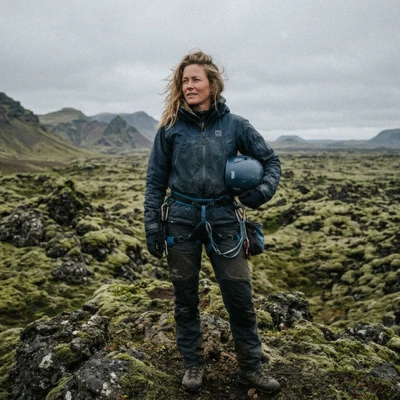
Your guide
Sigrún Ólafsdóttir
Caving and mountain guide, Reykjanes and Bláfjöll · working the lava fields south of Reykjavík since 2016
Ten seasons guiding in the lava country between Reykjavík and Bláfjöll, including summers on the crater rim. Re-checks both listings and the road to the meeting point every season, and will say plainly when a lava tunnel at a seventh of the price is the better day out.
Guides
Before You Book
Three things people ask us after they have read the prices: how to actually reach the meeting point, whether the descent earns its price, and what you can see without paying at all.
 Thrihnukagigur Volcano
 from $433Best Price — 4.9★, 628 Reviews